Abstract
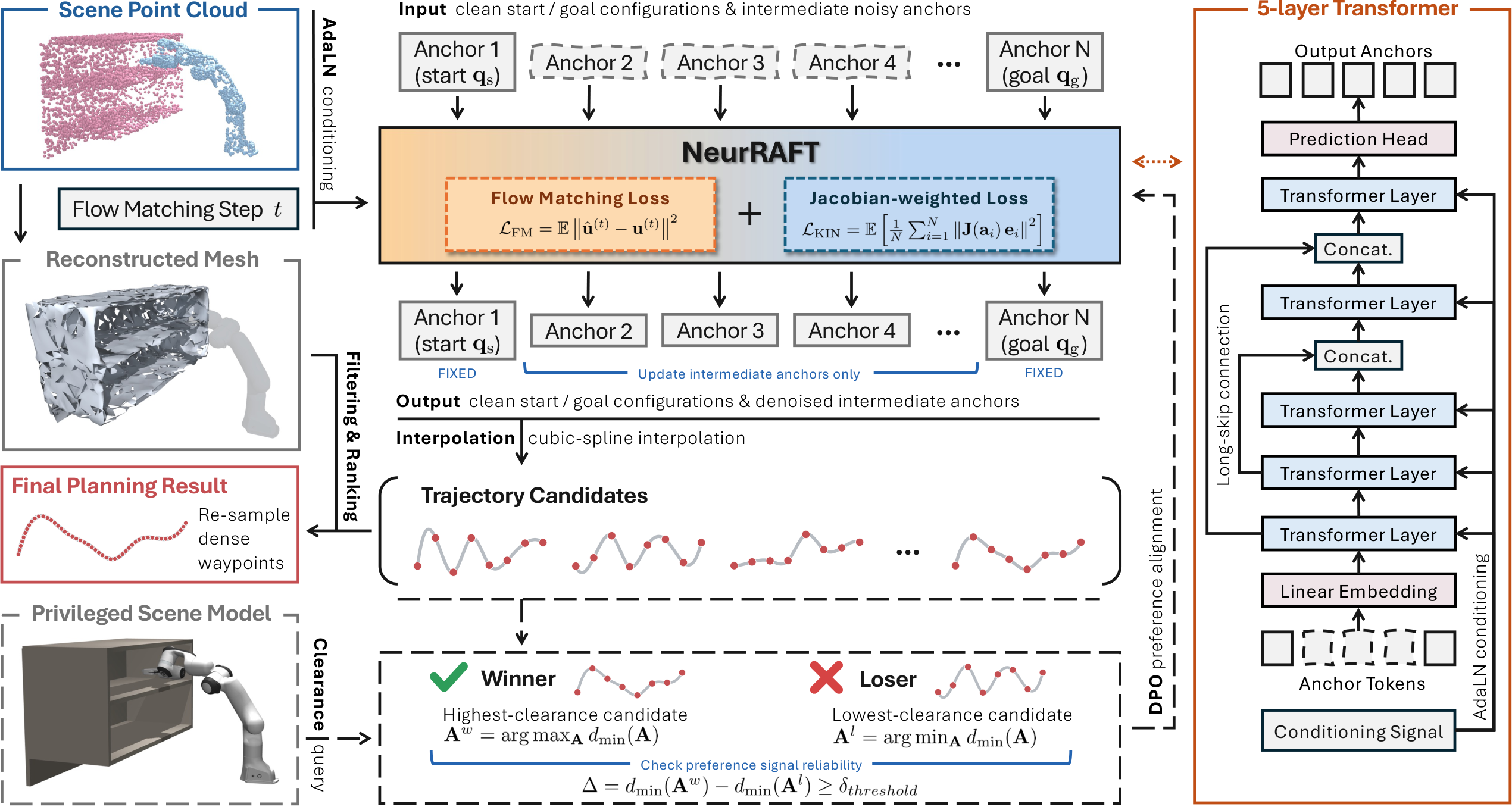
Recent end-to-end neural motion planners generate trajectories directly from raw sensor observations, enabling operation without privileged geometric models typically required by classical motion planners. However, generating collision-free trajectories for robot manipulators in cluttered environments remains challenging. In this work, we present NeurRAFT, a generative planning framework based on anchor-level flow matching and clearance-aware preference tuning. Unlike prior neural planners that model dense waypoint sequences, requiring the network to spend capacity on highly redundant local details and trajectory smoothness, NeurRAFT operates on a compact set of anchor waypoints. These anchors are generated in a single shot with as few as two flow-matching integration steps, using a Jacobian-weighted loss to account for their task-space impact. A smooth, full-resolution trajectory is then recovered by cubic-spline interpolation. While imitation learning from positive demonstrations does not explicitly distinguish collision-free trajectories from near-collision ones, collision-prone behaviors can therefore persist at test time. Unlike existing works that improve planning success through post-hoc corrections, such as additional inference-time modules or optimization procedures, we instead argue that the pretrained planner already captures feasible solutions within its learned distribution. The key challenge is therefore to reshape this distribution rather than augment the inference process. Motivated by this perspective, we use direct preference optimization to shift probability mass toward trajectories with larger obstacle clearance, directly absorbing the improvement into the neural planner parameters while leaving inference unchanged. Experiments on a large-scale motion planning benchmark show substantial improvements over state-of-the-art planners, while real-world experiments demonstrate zero-shot transfer to a physical Franka robot under noisy and partially occluded depth observations.
Method Overview
Real-World Experiments Playback speed 1×
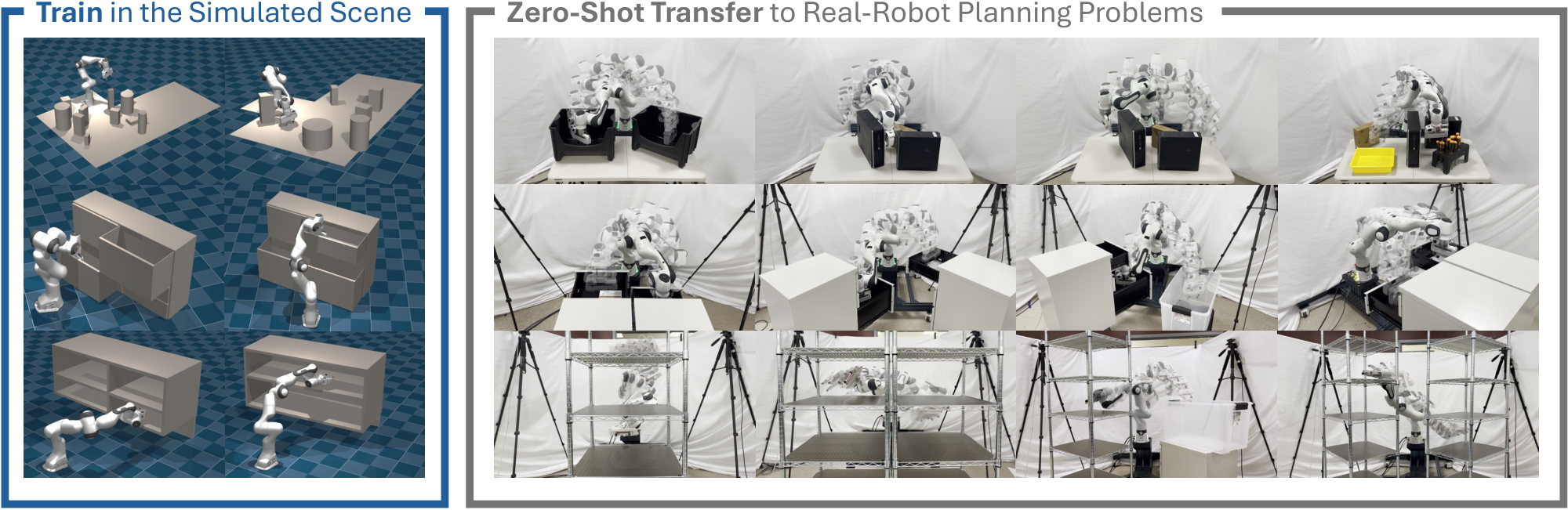
Zero-shot transfer to a physical Franka manipulator. The planner receives only depth observations, under sensor noise and partial occlusion, with obstacle layouts never seen during training. All clips play in real time — no speed-up, no cuts.
Qualitative Comparison of Preference Alignment
Each pair shows the same planning problem solved by the NeurRAFT supervised pretraining (left) and by NeurRAFT after clearance-aware preference tuning (right). The orange curve traces the end-effector through the trajectory.
Cubby
Dresser
Tabletop
Benchmark Quantitative Results
Success rate (%) on the three held-out test splits of the MπNets benchmark, each containing 1,800 planning problems. Glob. and Hyb. denote training on demonstrations from the global and the hybrid expert. Classical planners need no demonstrations, so a single value covers both.
Classical planner Neural planner NeurRAFT, pretraining only NeurRAFT — “trivially 100” marks planners that solve a split by its own definition; “not reported” marks numbers absent from the original paper.
Real-World Quantitative Results
Success rate (%) on the three real-world task families, before and after clearance-aware preference tuning.